Monday, 12 March 2012

Arrivals...


I decided to look at Manchester for my arrival point as the start of the unit. I thought it would be fitting to look at the city and the immediate surroundings of the art school to add history and context to my ideas. I wrote a short piece describing the scenes I saw when I first visited Manchester and ended in the Northern Quarter which is where I have decided to focus my attention at this point in Unit X.
I made some drawings from memory that related to my 'short story'.


I then visited the Northern Quarter to gather research and take photographs. I started to take photos of backstreets and the brickwork but then discovered the metal tiles in the floor about half way up 'Oldham Street'. They are symbolic tiles with images and patterns synonymous with Manchester and what was once the underground music scene. This made me think about the marks and the memories people have made and left in and upon Manchester. Hopefully this idea of memories and mark making will feed into my work and help me to produce some amazing ideas!


Sunday, 19 February 2012

SAMPLING Evaluation...

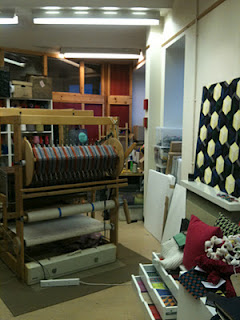
I am very pleased with the samples I have produced throughout the whole of the sampling unit however I am especially pleased with how the second half of my project has developed. I produced a lot more research than in the first half and I have enjoyed working towards more of a goal. I think my drawing and time management skills have improved again and the experimental side of my practice has gained a little more momentum. I have been working hard in the weave room nearly every day to produce my samples and this has lead me to discover that I think woven textiles is the main area of practice that I would like to develop, even though I have really enjoyed print and I thought that that would be my favoured discipline. 

 
In my personal brief I wrote about looking at colour more than imagery, which i have done however imagery has played a bigger part in my weaving than I had first anticipated and I have found this to be a good thing as it links the first and second half of my project well. 


I have tried to think about structure in my weaving by adding extra weft and using other techniques such as seersucker and floats rather than just thinking about a flat surface however after finishing the samples I have come to realise that maybe some of these techniques would not suit fabrics for fashion which I originally was aiming towards. The thicker fabrics may be more suitable for interiors or just pieces of art however I could think about toning them down or making them thinner to make them more suitable for fashion.
 A contemporary weaver called Laura Thomas inspired me in the structure of my weaving and also to think about how I can manipulate my woven samples after being taken off the loom. 

 'Loose Threads- Emerald'

For example I decided to weave some cream/ white samples to dye after being on the loom as I found I really enjoyed dip dying fabrics whilst using print in the first half of the project. I also thought this would make a good link between the two halves.


Overall I think that this project has been a success however an area I could work on is contextualising and using more influences from contemporary artists which is what I will aim to do in future projects. I think I will also continue to use more than one sketchbook in my projects as it has worked well for me to have a separate book for research and drawings, I find this helps me to research and draw more out of my subject matter.


Laura Thomas


I came across Laura Thomas whilst looking for inspiration for my own weaving. Her use of colour caught my eye initially as she uses it subtly with graduations and blocks of bold colour. I also like her bold, modern designs which include a range of geometric shapes. However Laura doesn't just weave and leave it at that, she manipulates her weaving after she has taken it off the loom as in her work 'loose threads' in which she captures the essence of the warp alone within an acrylic casing. 


Laura studied woven textiles at the 'University of England, The Royal College of Art' and then went on to become one of the founders of the 'Ann Sutton Foundation' (a woven textiles research group).
She mainly uses an AVL 24 shaft loom with a width of 1 metre however some of her samples are created at small mills around the country.


Shelly Goldsmith Lecture

On Tuesday 7th Febuary I attended a lecture by Shelly Goldsmith about her work and practise. She talked about the thought processes behind her art and it became clear that there is always a reason and a meaning behind each piece. 
She started her career as a tapestry weaver however she has now turned more towards fine art textiles in which she seems to use a number of hand processes such as hand stitching. I like the sense of emotion behind her artwork, an example being her delicate printed children's dresses which showed images of natural disasters and traumatic scenes. 

 'No Escape'

I also found her newest work very interesting. It's about how she believes textiles and clothing can 'absorb' events and experiences of the owner throughout its life span and that these can never be washed away or forgotten. She used her families experiences to create pieces of art with stories stitched into them, usually where she thought the body would touch the inside of the clothing most. She also involved a lot of forensic links within this work. 


Shelly said that it is very important to her to research and explore for a long period of time before creating her work and that it is also important to push boundries and techniques to the limit.

Thursday, 9 February 2012

SAMPLES IN PROGRESS...

After testing out yarn qualities and various patterns I have started to create my final samples. Here are my samples in progress...


TBC...


Friday, 3 February 2012

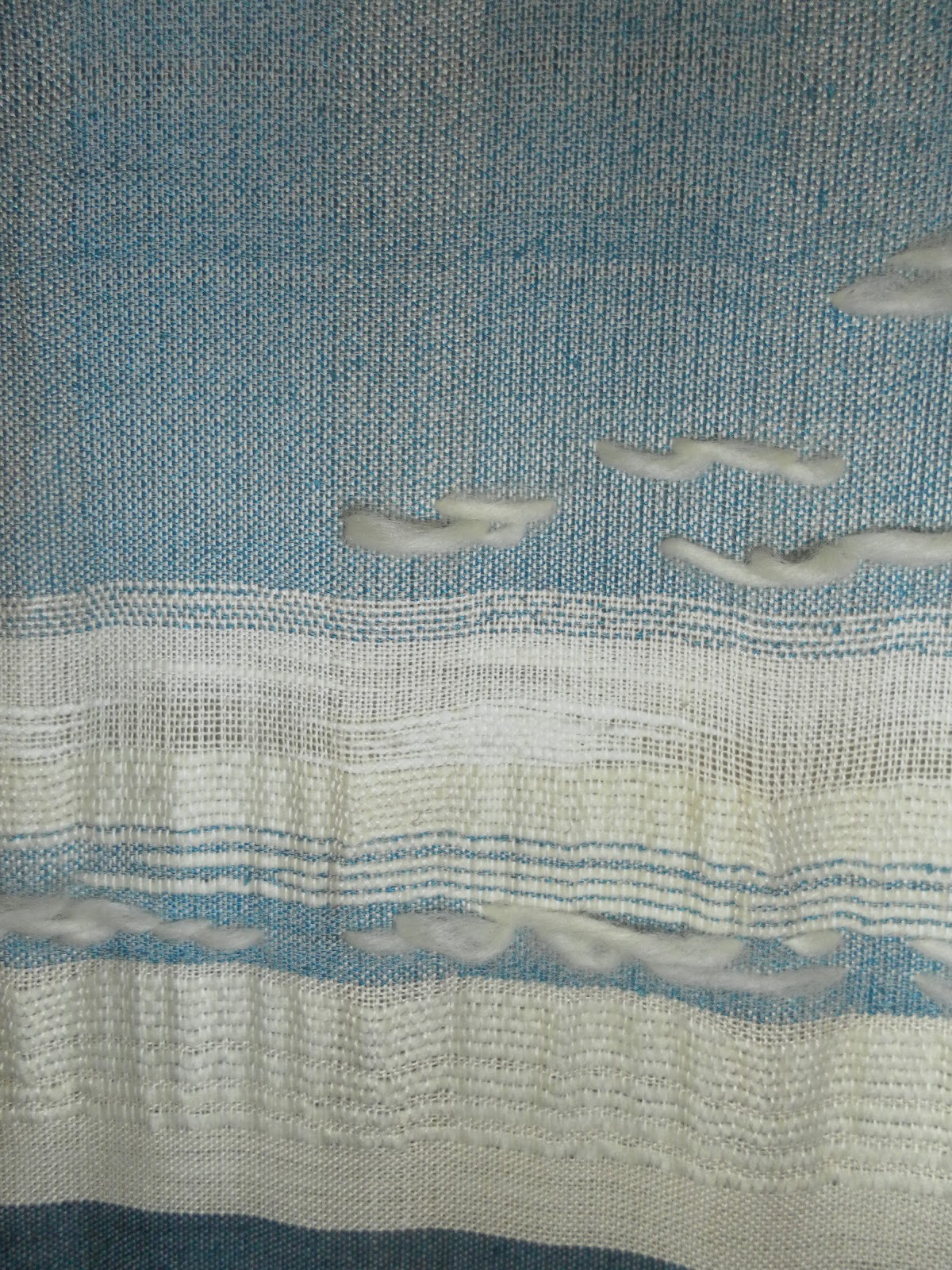
WEAVING THE SKY...

I have been testing out different yarns and patterns in my weaving to decide which techniques and colours to use in my final samples...


SAMPLING - Part 2

For the second half of the sampling unit I have decided to look at the 'change of colour in the sky' as I thought this would be an interesting and suiting development from my work in the first half.
I have taken images and started to translate the colour into drawings and colour wrappings.